
Libreria Ireti: Preserving Afro- Cuban Narratives
Libreria Ireti is the first bookstore in Cuba specializing in African literature from Cuba and the diaspora.A bookstore where the stories of African women are recognized, uplifted and preserved. Libreria Ireti grew out of the intention of making Afro-Cuban women writers more visible and through its commitment to African and Afro-Caribbean literature, Liberia Ireti ensures that important histories, perspectives, and experiences remain accessible to future generations
For members of the “Role of Women” delegation, whose visit centered on understanding the experiences and contributions of women in Cuban society, Libreria Ireti offered a unique opportunity to engage with a space dedicated to preserving and amplifying the voices of Afro- Cuban women. Eager to learn more about the bookstore’s mission, we arranged to meet its founder Katiuska Govan.
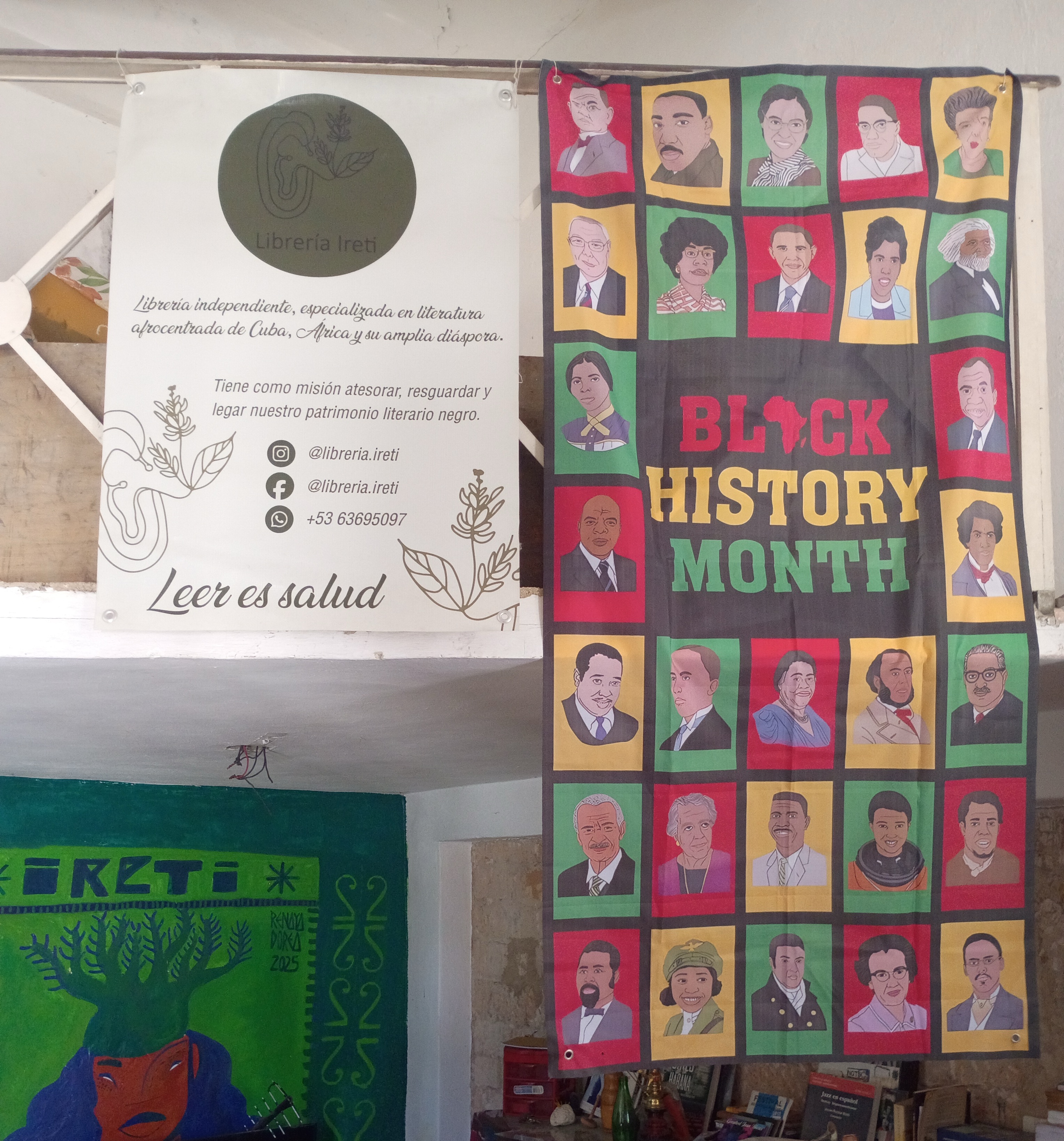
Set within Havana’s marginalized neighborhood of El Cerro, Libreria.Ireti occupies an unassuming space that could be easily overlooked by passerby.Upon entering, my delegation was greeted by a modest gathering place with large bright windows and a large Black History Month banner. The bookstore exuded a spirit of pride in Black history and achievement. Its modest size created an atmosphere that felt both intimate and purposeful.
With limited seating available, members of the “Role of Women” delegation gathered cross-legged on the floor reinforcing Govan’s idea that “Libreria Ireti community project, not a one-person project.” At the center of that community effort is Katiuska Govan, founder and curator of Libreria Ireti. Katiuska Govan, founder and curator of Libreria Ireti is an introspective and passionate librarian who spoke in detail about her transition from medical doctor to curator of a community bookstore. Against the backdrop of bright green tapestry bearing the word Ireti. She opened up the discussion by speaking to the meaning behind the bookstore’s name. Ireti Yoruba name in origin, derives from the Yoruba language spoken primarily in Nigeria and parts of West Africa means “hope”, “hopeful”, “expectation”. Govan described building the bookstore as an act of courage and personal growth. “It was a way to connect activism and work”.
She reflected on the lengths she went to in order to build the extensive collection, searching through private and public libraries, cultivating relationships with fellow readers and remaining attentive to opportunities to acquire rare books and works by Afro Cuban women that addresses uncomfortable but impactful topics such as race . One such author mentioned by Govan is Daisy Rubiera Castillo whose writing explores the impact of racism on Cuban Society and the anti -racism movement in Cuba. The theme of race resurfaced throughout our discussion with Govan. She noted that the Cuban revolution brought significant and long lasting advances but it did not eliminate racism altogether. As she explained “It’s not that the revolution ended racism, it just became dormant”. Her comment served as a reminder that preserving black stories is not simply about celebrating the past. It is also about creating space to confront silence and ensure that black experience remains visible within the historical record. At one point, the conversation turned to the 66 years of genocidal blockade that has impacted every aspect of Cuban life. Consequently, the economic blockade has had a profound impact on the circulation and access of books. Many bookstores have closed due to deteriorating infrastructure and the internationally recognized Havana Book Fair was postponed due to the United States’s tightening of the blockade, making the need for spaces like Libreria Ireti more apparent
As our conversation came to a close I found myself reflecting on the power of spaces like Libreria Ireti and how it serves as a cultural home, ensuring that the voices of afro-diasporic remain accessible to those who seek them . Long after leaving El Cerro I carry the understanding that preserving Afro Cuban narratives is not simply an act of remembrance – it is an act of resistance. It is a commitment to ensuring that Afro-Caribbean voices are heard, remembered and valued